Flooring & Tile
Deck Mud Calculator
Calculate deck mud for shower pans, pre-slope layers, floor mud, and flat mortar beds with slope, mix ratio, bags, and waste.
Calculator inputs
Deck Mud Calculator Results
Results update in your browser as you edit inputs. They are planning estimates, not complete shopping lists.
Enter project dimensions to calculate material quantity.
Assumptions
- Sloped shower pan volume is an estimate because actual shower pan geometry, drain location, and wall layout can vary.
- Center drain mode uses the farthest corner as a conservative slope run. Linear drain mode uses the entered width as the slope run.
- Bag yields are planning assumptions. Use the product label, manufacturer instructions, or your chosen mix recipe for final quantities.
- Sand and cement split is by volume from the selected mix ratio, not a product-specific recipe or safety instruction.
- Water ratio, substrate preparation, waterproofing, reinforcement, drainage, code requirements, and tile installation details are not included.
- This is a planning estimate only. Follow product instructions and consult a qualified professional for wet-area, shower, structural, or safety-critical work.
- Any cost estimate uses only the unit price you enter. No store or local price data is used.
Formula
- Area = length x width after converting dimensions to feet.
- Perimeter thickness = minimum thickness + slope per foot x run to the farthest edge.
- Average thickness = (minimum thickness + perimeter thickness) / 2 for sloped beds; flat beds use the base thickness.
- Flat bed volume = area x thickness in feet.
- Sloped bed volume is approximated as area x average thickness in feet.
- Bags = ceil(waste-adjusted cubic feet / selected bag yield).
- Sand and cement split = waste-adjusted volume x each part / total mix parts.
Deck Mud Calculator Examples
3 ft x 5 ft shower pan with center drain
A 15 sq ft shower pan with 1 in minimum thickness and 1/4 in per ft slope estimates about 1.68 cu ft before waste. With a 0.45 cu ft bag yield, that rounds up to 4 bags before extra waste.
- Area: 15 sq ft
- Minimum thickness: 1 in
- Slope: 1/4 in per ft
- Estimated bags: about 4 at 0.45 cu ft/bag
4 ft x 6 ft flat mortar bed
A 24 sq ft flat mortar bed at 1 in thick is about 2.00 cu ft before waste. With a 0.45 cu ft bag yield, the base estimate rounds up to 5 bags.
- Area: 24 sq ft
- Flat thickness: 1 in
- Base volume: about 2.00 cu ft
- Estimated bags: about 5
3 ft x 3 ft small shower pan
A small 3 ft by 3 ft shower pan (9 sq ft) with a 1 in minimum thickness, a center drain, and 1/4 in per ft slope estimates about 0.95 cu ft before waste. With a 0.45 cu ft bag yield, that is about 3 bags. Confirm the minimum thickness and slope against your product instructions and local code.
- Area: 9 sq ft
- Minimum thickness: 1 in
- Slope: 1/4 in per ft
- Estimated bags: about 3 at 0.45 cu ft/bag
32 sq ft walk-in shower floor mud bed
A 4 ft by 8 ft (32 sq ft) flat floor mud bed at 1.25 in is about 3.33 cu ft before waste. That is about 8 bags at 0.45 cu ft (60 lb) or about 6 bags at 0.60 cu ft (80 lb) before adding waste. Bag yields vary by product, so check the label.
- Area: 32 sq ft
- Flat thickness: 1.25 in
- Base volume: about 3.33 cu ft
- Estimated bags: about 8 (60 lb) or 6 (80 lb)
6 ft x 4 ft mortar bed at 1.5 in
A 6 ft by 4 ft (24 sq ft) flat mortar bed at 1.5 in is about 3.00 cu ft before waste. That is about 7 bags at 0.45 cu ft (60 lb) or 5 bags at 0.60 cu ft (80 lb). A thicker bed uses more material, so verify the required thickness for your installation.
- Area: 24 sq ft
- Flat thickness: 1.5 in
- Base volume: about 3.00 cu ft
- Estimated bags: about 7 (60 lb) or 5 (80 lb)
Units and Parameters Quick Reference
Deck mud parameters
Deck mud estimates depend on area, thickness, slope, yield, and mix ratio. Wet-area installation details must come from product instructions and qualified guidance.
| Input | Unit | Planning note |
|---|---|---|
| Minimum thickness | in | Base thickness at the drain or flat bed thickness. |
| Slope per foot | in/ft | Default 1/4 in per ft is editable. |
| Bag yield | cu ft/bag | Use the yield for the mix or bag you plan to use. |
| Mix ratio | sand:cement | Used for a volume split only, not a mixing instruction. |
| Waste factor | % | Adds material for uneven substrate and field loss. |
Sloped shower pan geometry varies, so the calculator uses a conservative approximation.
How to Use the Deck Mud Calculator
Choose the application type, drain type, dimensions, base thickness, slope, mix ratio, bag type, and waste factor. The result updates in the browser and shows volume, bag count, sand and cement split, and coverage by the entered thickness.
Use flat bed mode for level mortar beds. Use center or linear drain mode for a conservative sloped-bed estimate.
Shower Pan vs Floor Mud vs Pre-Slope
A shower pan or pre-slope usually uses a sloped mortar bed, so the calculator estimates perimeter thickness and average thickness. A flat mortar bed or floor mud area uses the same thickness across the whole area.
If you enable the pre-slope layer option, the calculator adds a second estimated layer with the same area and slope assumptions.
Deck Mud Mix Ratio
The mix ratio controls the sand and cement split by volume. A 5:1 ratio means five parts sand to one part cement. A 4:1 ratio means four parts sand to one part cement.
This split is a planning estimate only. Use manufacturer instructions or a qualified installer for the final recipe, water ratio, and installation method.
How Slope Changes Mud Volume
Slope increases mud volume because the perimeter is thicker than the drain area. The calculator estimates perimeter thickness as minimum thickness plus slope per foot times the run to the farthest edge.
For center drains, the run is approximated from the center to the farthest corner. For linear drains, the run is approximated across the entered width.
Deck Mud Coverage Chart
Coverage per bag depends almost entirely on how thick the bed is. The thicker the mud bed, the less floor area one bag covers. This chart assumes a 60 lb bag yields about 0.45 cu ft and an 80 lb bag yields about 0.60 cu ft, using coverage = bag yield divided by thickness in feet.
Bag yields vary by product and how the mud is mixed and packed, so always check the yield printed on the bag and confirm the required thickness for your application.
Square feet covered per bag by thickness
Approximate floor area covered by a single bag at each finished thickness, before adding a waste factor.
| Bed thickness | 60 lb bag (~0.45 cu ft) | 80 lb bag (~0.60 cu ft) |
|---|---|---|
| 0.5 in | about 10.8 sq ft | about 14.4 sq ft |
| 1 in | about 5.4 sq ft | about 7.2 sq ft |
| 1.5 in | about 3.6 sq ft | about 4.8 sq ft |
| 2 in | about 2.7 sq ft | about 3.6 sq ft |
| 2.5 in | about 2.2 sq ft | about 2.9 sq ft |
| 3 in | about 1.8 sq ft | about 2.4 sq ft |
Coverage figures are rounded planning estimates with no waste factor. Sloped beds vary in thickness, so use the average thickness from the calculator. Verify the yield on your product.
Coverage by area and thickness
| Area | Thickness | Cubic feet | Estimated 60 lb bags | Estimated 80 lb bags |
|---|---|---|---|---|
| 15 sq ft | 1 in | 1.25 cu ft | 3 bags | 3 bags |
| 24 sq ft | 1 in | 2.00 cu ft | 5 bags | 4 bags |
| 24 sq ft | 1.5 in | 3.00 cu ft | 7 bags | 5 bags |
| 40 sq ft | 1.5 in | 5.00 cu ft | 12 bags | 9 bags |
Bag counts are rounded up and do not include waste unless you add it in the calculator.
Bag Count Examples
Worked examples
| Example | Square feet | Thickness / slope | Volume | Bag count |
|---|---|---|---|---|
| 3 ft x 5 ft shower pan | 15 sq ft | 1 in minimum, 1/4 in per ft slope | About 1.68 cu ft before waste | 4 bags at 0.45 cu ft/bag |
| 4 ft x 6 ft mortar bed | 24 sq ft | 1 in flat bed | 2.00 cu ft before waste | 5 bags at 0.45 cu ft/bag |
Examples are planning estimates. Enter your actual dimensions, slope, waste factor, and bag yield above.
What Deck Mud Is (and What It Isn't)
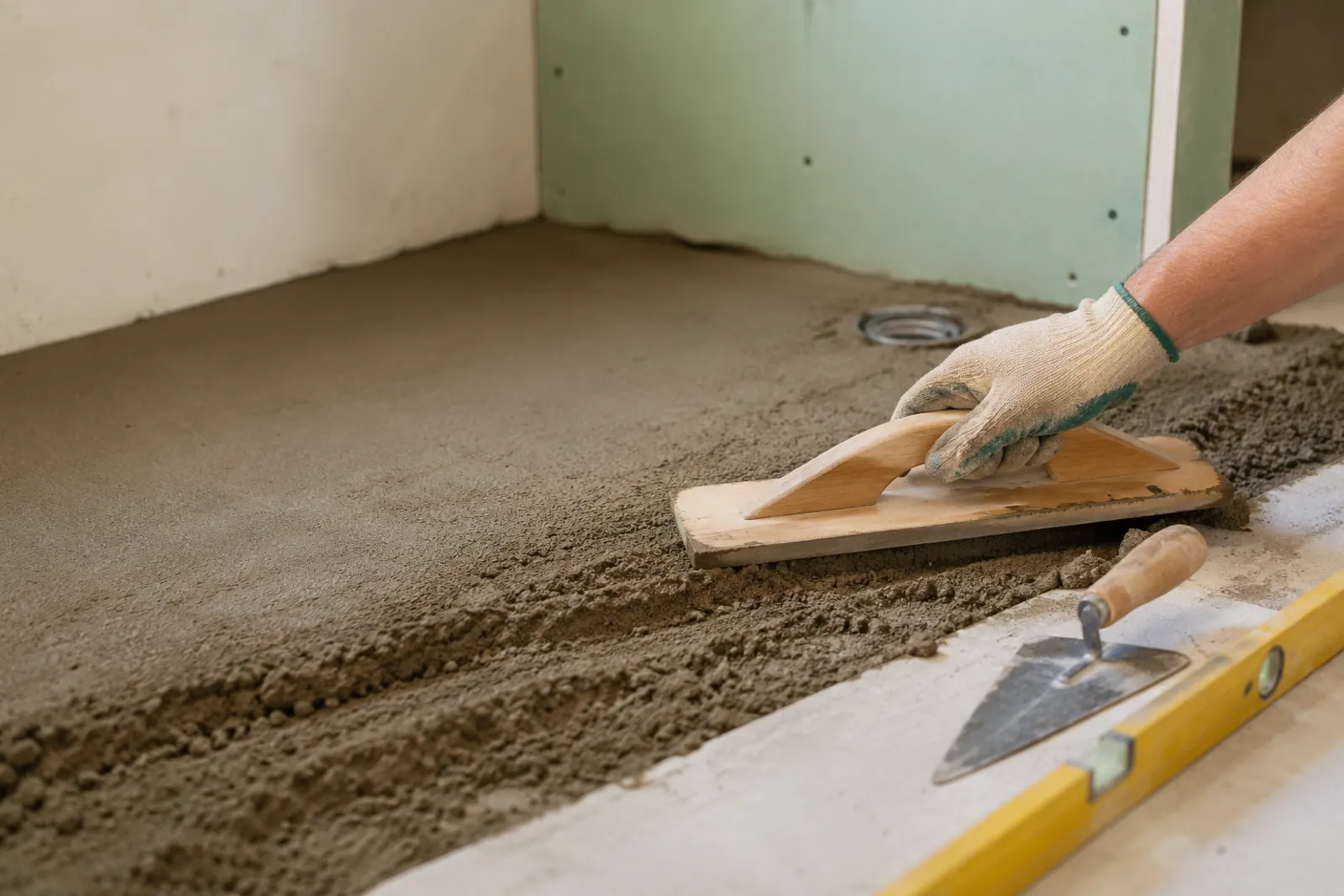
Deck mud, also called dry-pack mortar or floor mud, is a stiff blend of sand and portland cement with only enough water to hold its shape when packed. It is used to build sloped shower pans, pre-slope layers under a liner, and flat leveling beds beneath tile. Because it is mixed dry and packed, it can be shaped to a slope and screeded flat.
Deck mud is not the same as thinset, which is a bonding mortar used to set tile onto a surface. It is also not a self-leveling underlayment, which is poured wet to flow level on its own, and it is not structural concrete with aggregate. Using the wrong material for the wrong layer is a common and costly mistake, so match the product to the layer and follow the manufacturer instructions.
Common Deck Mud Mistakes
- Using only the drain thickness for a sloped shower pan instead of the average thickness across the slope.
- Forgetting that the farthest wall or corner controls the high side of the slope, which sets the slope to the drain.
- Building too little slope, which can leave standing water that does not drain toward the outlet.
- Mixing the mud too wet, which can weaken the bed and make it hard to pack and hold a slope. Follow the product water guidance.
- Skipping the pre-slope layer under a liner where the waterproofing method calls for one.
- Making the bed too thin, which can crack or fail to hold shape, or using bag count without checking the product yield.
- Treating a volume estimate as waterproofing, drainage, slope, or code guidance.
Buying Deck Mud Materials
These are general buying notes for planning, not product endorsements. Confirm that any product you buy is rated for your application and follow its instructions.
- Use a sharp or masonry sand rather than play sand, because the angular grains pack and hold a slope better. Check that the sand is suitable for mortar use.
- For small jobs, pre-blended bags are often easiest. For larger beds, buying bulk sand plus portland cement separately can cost less, but you measure the ratio yourself.
- Pre-blended deck mud, sand-topping, or floor mud products such as those from brands like Quikrete or Sakrete can save measuring, since the sand and cement are already combined. Confirm the bag is rated for your layer.
- Buy a little extra, often around 10 percent, for waste, uneven substrate, and field adjustments.
- Keep cement and pre-blended bags dry before use, since moisture can ruin unused product.
Deck Mud Materials You May Need
These are the common supply categories for a deck mud (dry-pack mortar) project. Confirm product suitability and mix ratios with the manufacturer before buying.
- Masonry or sharp sand (washed, well-graded concrete sand).
- Portland cement (Type I/II), or a pre-blended deck mud / sand-topping mix.
- Clean water plus a mixing tub or wheelbarrow for mixing.
- Optional latex or acrylic bonding admixture for bonded mortar beds.
Related tile planning tools
Use this calculator for deck mud volume only. For tile piece count, use the tile calculator after the mortar bed area is known.
Example calculation
Example: 3 ft x 5 ft shower pan
A 3 ft by 5 ft shower pan is 15 sq ft. With a 1 in drain thickness and 1/4 in per foot slope to the farthest corner, the calculator estimates average thickness, cubic feet, and rounded bag count.
Common mistakes
- Using the thinnest point instead of an average thickness for a sloped mortar bed.
- Ignoring the yield printed on the bag or mix instructions.
- Treating this quantity estimate as waterproofing, slope, drainage, or installation guidance.
- Skipping waste when the substrate is uneven or the layout needs field adjustments.
FAQ
What is the deck mud ratio?
Common deck mud mixes are often discussed as 5:1 or 4:1 sand to cement by volume. This calculator lets you choose 5:1, 4:1, or a custom ratio, but final mix instructions must come from your product or project requirements.
How many bags of deck mud do I need for a 3x5 shower pan?
Use 15 sq ft as the area, enter the drain thickness, slope per foot, bag yield, and waste factor, then round the bag count up. The exact count depends on slope run and bag yield.
How do I calculate slope to the drain?
Slope height is approximated as slope per foot times the run from the drain to the farthest edge. Center drain mode uses the farthest corner; linear drain mode uses the entered width.
Is floor mud the same as deck mud?
The terms are often used for similar dry-pack mortar bed material, but product instructions and installation requirements can differ. This calculator estimates quantity only.
What depth should a shower pan mud bed be?
Use the minimum thickness and slope required by your product instructions, local requirements, and qualified installer. This calculator does not set construction requirements.
How much deck mud do I need for a shower pan?
It depends on the pan area, the minimum thickness at the drain, and the slope to the drain. As a rough planning method, multiply the area in square feet by the average thickness in feet to get cubic feet, then divide by the bag yield. A typical small pan can use anywhere from a few bags upward. Enter your own dimensions, slope, and yield in the calculator, and confirm the required thickness and slope against your product instructions and local code.
How many bags of deck mud do I need per square foot?
Bag coverage depends on thickness. At about 1 in thick, a 60 lb bag (around 0.45 cu ft) covers roughly 5.4 sq ft and an 80 lb bag (around 0.60 cu ft) covers roughly 7.2 sq ft. Coverage drops as the bed gets thicker, so a 2 in bed roughly halves those numbers. Always verify the yield printed on your bag, because products differ.
Should I use a 5:1 or 4:1 deck mud mix?
Deck mud is commonly discussed as about 5:1 sand to portland cement by volume, with some installers using a richer 4:1 mix for added strength. The right ratio and water amount depend on the product and the installation, so follow the manufacturer instructions or a qualified installer rather than treating any single ratio as a rule.
What is the difference between deck mud, floor mud, and dry pack mortar?
These terms usually describe the same family of stiff, dry-pack mortar made from sand and portland cement with only enough water to hold its shape. The names vary by region and use, such as a shower pan, a pre-slope, or a leveling floor bed. Some bagged sand-topping or floor mud products differ slightly in blend, so check that the product you buy is rated for your application.
How thick should a deck mud bed be?
Thickness depends on the application and product. Many shower mud beds use a minimum thickness at the drain that increases toward the perimeter because of the slope, while flat leveling beds use one thickness throughout. Too thin a bed can crack or fail to hold slope. Use the minimum and maximum thickness allowed by your product instructions and local code.
What slope does a shower pan need?
A widely cited guideline for shower floors is about 1/4 in per foot of run toward the drain, but the required slope can vary. Confirm the correct slope with your product instructions and local plumbing code before building the pan. The calculator uses your entered slope only to estimate material volume, not to set a code requirement.
Can I use deck mud for a pre-slope layer?
Dry-pack deck mud is commonly used for a pre-slope beneath a waterproofing liner, with a second sloped bed built on top. The calculator's pre-slope option estimates a second layer using the same area and slope assumptions. Follow your waterproofing manufacturer's method for liner placement, pre-slope, and the order of layers.
Related Planning Tools
Use these related calculators when the same project needs another material estimate. Each link opens a browser-based tool with its own assumptions and formulas.