Concrete planning guide
Recommended Concrete Slab Thickness for Patios, Sheds, and Driveways
Learn how slab thickness affects concrete volume, bag count, and planning assumptions before estimating material quantity.
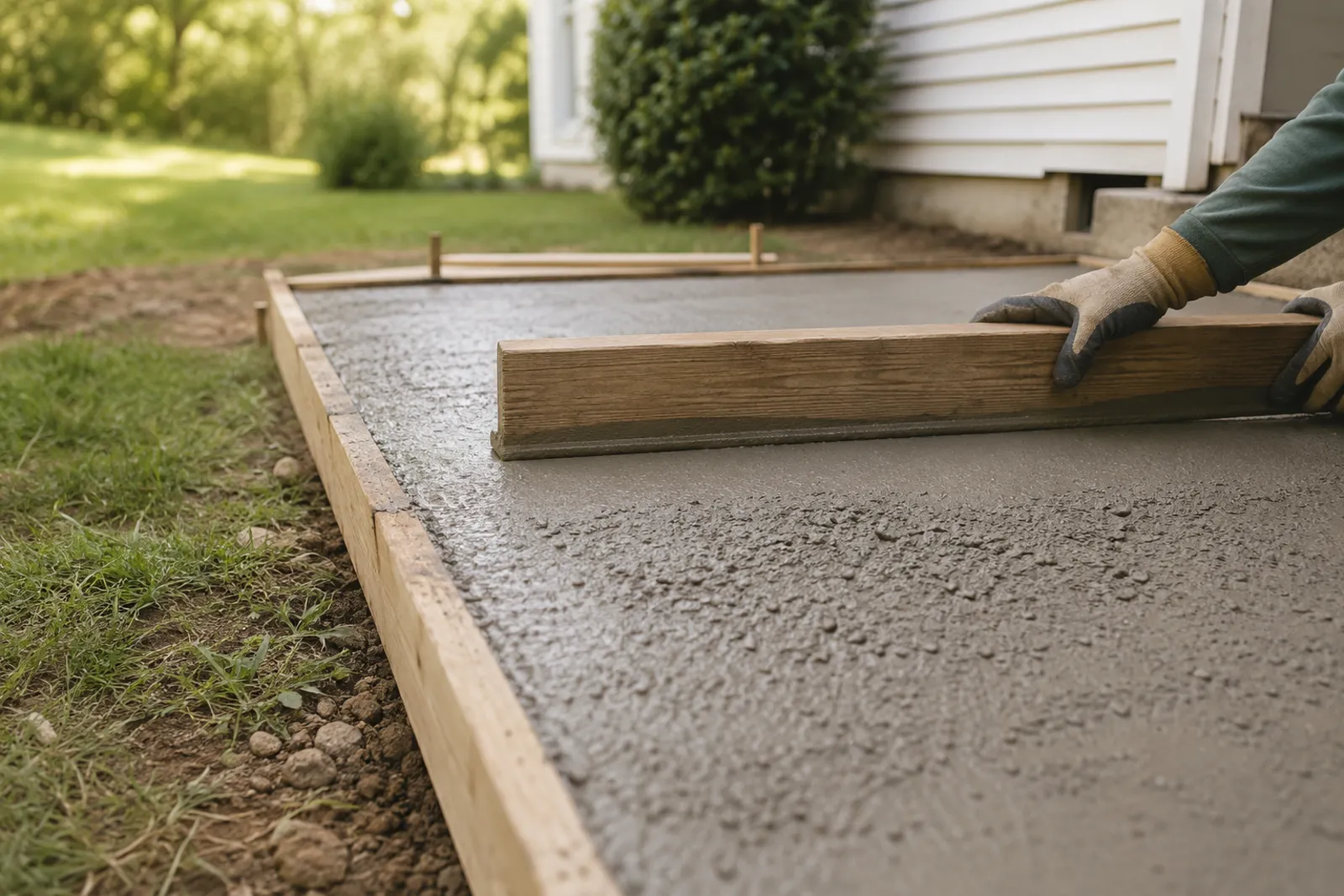
Concrete slab thickness is one of the largest drivers of material quantity. If the length and width stay the same, increasing thickness from 4 inches to 6 inches increases concrete volume by about 50%. Increasing from 4 inches to 8 inches doubles the volume.
This guide explains common planning ranges only. It is not structural engineering, building-code guidance, soil evaluation, or permit advice. Loads, reinforcement, base preparation, drainage, climate, and local requirements can all change the slab design.
Common slab thickness planning ranges
| Project type | Common thickness | Why it matters | Planning caution |
|---|---|---|---|
| Patio or walkway | 4 in is common for many light-duty plans | Thickness controls volume and helps resist surface movement when base prep is adequate. | Poor soil, freeze-thaw conditions, or heavy loads may require a different design. |
| Small shed slab | 4 in to 6 in is often considered in early planning | A shed may add concentrated loads from walls, equipment, or storage. | Confirm requirements for the shed, anchors, local permits, and base preparation. |
| Garage or driveway | 6 in or more may be considered for heavier use | Vehicle loads make slab thickness and reinforcement more important. | Do not rely on a quantity guide for structural driveway design. |
| Hot tub, heavy equipment, or masonry support | Project-specific design needed | Point loads can exceed simple slab assumptions. | Consult product instructions and qualified professionals before estimating only from area. |
The table is for early material planning, not final slab specification.
Example: why 6 inches needs more concrete than 4 inches
Inputs
- Area: 100 sq ft
- Thickness A: 4 in
- Thickness B: 6 in
Estimated result
At 4 inches, volume is about 33.33 cu ft. At 6 inches, volume is about 50.00 cu ft.
The 6 inch slab is 1.5 times as thick, so the volume is also 1.5 times as much when the area is unchanged.
Example: 12x12 slab at 4 inches versus 6 inches
Inputs
- Area: 144 sq ft
- 4 inch volume: 48.00 cu ft
- 6 inch volume: 72.00 cu ft
Estimated result
The 6 inch version adds about 24.00 cubic feet, or 0.89 cubic yards, before waste.
For larger slabs, a small change in thickness can add a large number of bags or a meaningful fraction of a cubic yard.
Thickness is not the whole slab design
Base gravel, compaction, reinforcement, control joints, drainage, soil support, and local requirements can matter as much as thickness. Use this guide for quantity planning only.
Estimate volume after choosing a planning thickness
Compare cubic yards and bag counts for a 10 ft by 10 ft slab at 4, 6, and 8 inch thicknesses.
Related resource gravel base cubic yard and tons calculatorEstimate gravel volume and approximate tons when a project also needs a compacted base layer.
FAQ
Is 4 inches thick enough for a concrete patio?
Four inches is a common planning thickness for many light-duty patios, but final requirements depend on soil, base prep, drainage, reinforcement, climate, and local rules.
How does slab thickness affect concrete quantity?
Volume equals area times thickness. If area stays the same, a thicker slab increases material quantity in direct proportion to the thickness.
Can this guide choose a driveway slab thickness?
No. Driveways carry vehicle loads and often need project-specific design decisions. Use the guide only to understand how thickness changes material quantity.
Should I include a waste factor for concrete?
Yes, many planning estimates add waste for uneven forms, excavation variation, and spillage. The calculator lets you adjust that percentage.
Sources and review notes
Reviewed . These references support the unit conversions and planning assumptions on this page. Confirm the exact product label and local project requirements before buying material.
- How the calculations work HomeMaterialCalc. How HomeMaterialCalc handles formulas, rounding, browser-based calculations, and prices you enter.
- NIST Guide to the SI, Appendix B: Conversion Factors National Institute of Standards and Technology. Length, area, and volume unit conversions used in calculator formulas.
- QUIKRETE Concrete Mix No. 1101 data sheet QUIKRETE. Planning yields for 40 lb, 60 lb, and 80 lb concrete bags.